
This is a sneak preview -- you are seeing this page because you need to possibly
approve this content and get back to us. Have a great day!
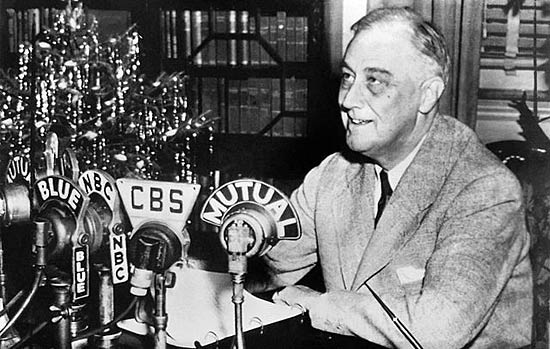
Creative Commons: Image by National Archives and Records Administration
In case you haven't heard, presentations delivered standing behind a lectern are out and fireside chats are in. Whether it is an effort to emulate the format originated by President Franklin D. Roosevelt or an effort to avoid the curse captured by the old Jerry Seinfeld joke: "To the average person, if you go to a funeral, you're better off in the casket than doing the eulogy," chats are the new way to present.
FDR, whose patrician voice and dignified manner made him sound formal and distant, developed the fireside chat to create a more intimate bond with the public. But the format has another equally-important benefit and, although FDR didn't need the help, it reduces the pressure that presenters invariably feel when they are the sole center of attention. "Yikes! They're all looking at me!"
In my pre-presentation coaching career, I was a producer/director of public affairs and news programs at WCBS-TV, and I used the chat format to reduce the pressure that our guests—from the business, scientific, academic, and governmental sectors— invariably felt when they appeared in front of live television cameras. "Yikes!"
We put our guests in dialogues with professional anchorpersons or hosts. The format is still used today and has broadened from in-studio to two-way split-screen exchanges from remote locations. Today, I use the same conversational approach in coaching presentations.
If you are invited to a give a fireside chat, here are four simple recommendations to help you do it well:
 This blog post by Jerry Weissman was first published on his site at Forbes. He has written five books on presentation skills. His most recent, Winning Strategies for Power Presentations, published by Pearson, is available now from Amazon.
Microsoft and the Office logo are trademarks or registered trademarks of Microsoft Corporation in the United States and/or other countries.